We know everything about cricket stars. But do you know the five Indian students who just made India ranked number one in the world in physics?
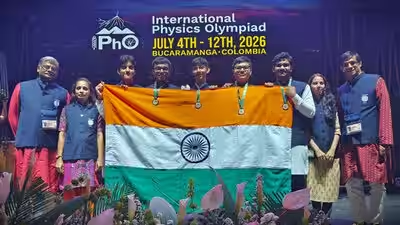
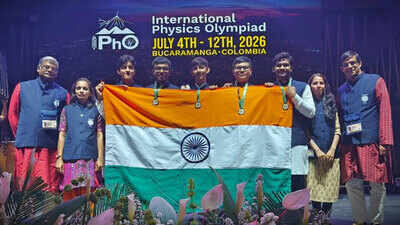
If you ask an Indian teenager named Virat Kohli, Neeraj Chopra or PV Sindhu, the answer will come out immediately. But ask the same student about Kanishk Jain, Riddhesh Anant Bendale, Rishit Garg, Shresth Suraiya or Svarit Joshi and chances are you will get silence.Yet these five students achieved something worthy of national celebration.Representing India at the 56th International Physics Olympiad (IPhO) in Bucaramanga, Colombia in 2026, all five players returned home with gold medals, helping India rank first in the world alongside scientific powers such as China, Russia, Kazakhstan, South Korea and Taiwan. This is the second time that India has swept five gold medals in this prestigious competition.
‘This is not another competitive exam’
Responding to India’s strong performance, product lead and former JEE physics teacher Malay Krishna explained why the results were so different from the test most Indian students are familiar with.“I taught JEE Physics for many years. That paper beat tough kids in three hours,” he wrote on X.“But this exam included five hours of theory and five hours of lab work, and these five guys got close to perfect scores.”His post resonated with thousands of people because it explained why the International Physical Olympiad is one of the toughest academic competitions in the world.Unlike entrance exams, which usually test speed and familiarity with question patterns, Olympiads require original thinking. Students spend five hours solving advanced theoretical physics problems and then move on to another five-hour laboratory exam in which they are required to design experiments, analyze data, estimate errors, and use unfamiliar laboratory equipment to draw scientific conclusions.As Malay Krishna said: “You either understand physics or you sit there for five hours.”
Five students who made history
This year’s Indian team members include:• Kanishk Jain from Pune • Riddhesh Anant Bendale from Indore • Rishit Garg from Dwarka, Delhi• Shresh Suraiya from Mumbai • Swarit Joshi from AhmedabadThe Indian team competed against 381 students from over 85 countries and each member won a gold medal.According to the Department of Atomic Energy (DAE), this achievement reflects the strength of India’s Olympic program, which is coordinated by the Homi Bhabha Center for Science Education (HBCSE), a national center at the Tata Institute of Fundamental Research (TIFR).The program identifies talented students through multiple stages of national-level examinations and then puts them through rigorous training camps that ultimately result in India’s final five-member team.
Behind every medal lies years of scientific thinking.
Malay Krishna also highlighted something that is often overlooked in the discussion surrounding competitive exams.He points out that while coaching institutions are very good at helping students deal with known problem patterns, Olympiads require an entirely different skill set—thinking about problems students have never faced before.“There are no shortcut chapters. No formula sheets can save you,” he wrote.He believes this capability has been quietly cultivated for decades through India’s publicly funded Olympic ecosystem.India’s consistent position supports this statement. This is the country’s 27th participation in an international physical Olympiad. Over the past decade, every Indian competitor has won a medal, with most of them winning gold.However, this success also raises a larger question about developing scientific talent. Malay Krishna noted that while a large proportion of India’s Olympic medalists went on to pursue doctoral studies, many ended up building their careers abroad.“They won every option,” he wrote, adding that India had become exceptionally good at identifying and training scientific talent. The next challenge, he suggested, is to create opportunities to encourage more people to continue working at home.For now, though, the spotlight belongs to five young physicists who have quietly achieved extraordinary things.Their names may not be household names yet, but their achievements place India alongside the world’s best in one of the toughest science competitions on earth. Maybe this is enough for every student and every parent to remember them.Disclaimer: This article is based on public information, official announcements, and statements shared by relevant individuals on LinkedIn. For contextual purposes, quotes are copied from his public posts.




























Post Comment