FIFA World Cup: On triangles, tactical nuances and La Roja’s road to the final | Football News
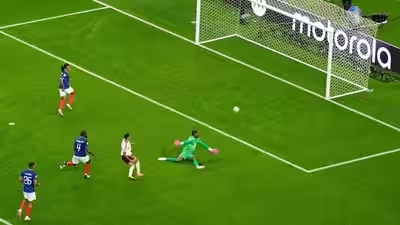
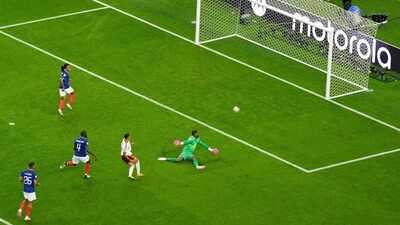
The vignettes of some of the game’s scenes unfold in fairly alternating order. Spain’s 2-0 demolition of France in the first semifinal of this expanded World Cup on Tuesday resembled an elegant dissection of the abstract with unfathomable sincerity and tireless determination.Taken at face value, the challenge of facing France actually seems like a puzzle that is too awe-inspiring and confusingly abstract to solve for any team. They are the team to beat, an attacking juggernaut that crushes one opponent after another with utter disdain. The stage is apparently set for Didier Deschamps and Kylian Mbappe’s Les Bleus to embrace immortality. Although this turned out to be only a possibility because Spain came and injected a French idea of dominance that was an irrepressible force at odds with their own feeling of La Furia.An uncharacteristically banal France meets their match in an extraordinarily beautiful Spain. A France entered the examination hall with the pride of a class leader and suddenly looked at the growing confusion. And Spain, perhaps a bit detached from all this pre-match mayhem, basked in the joy of passing the test with neat skill.The arc of the narrative flip is evoked in the pages of Johan Cruyff’s book embedded in the psyche of Spanish football. This is a victory sketched in triangles.Cruyff’s obsession with possession led him to create a model based on triangles. Regardless of his position on the pitch, a player must position himself to continue forming geometric shapes, thus enabling him to offer a teammate more than a passing option. “It’s not the man with the ball who decides where the ball goes, but the players without the ball,” the Dutch legend – the center of Total Football by Rinus Michels – once said.Cruyff’s arrival in Catalonia first as a player and then as coach of FC Barcelona spread the stardust of this idea throughout Spanish football’s mind-space and continued the formation of his ‘dream-team’ project. It has changed – from Pep Guardiola to Vicente del Bosque to Luis Enrique and now Luis de la Fuente. The triumph of geometry has since then been the calling card of Spain. It provoked debate, amused and even annoyed its listeners but was never neglected. France, who entered the competition as overwhelming favourites, may have played their worst game at the worst moment in this World Cup, but they could not have faced Spain at their glamorous best at a more inopportune time. Mbappe and his team-mates were reckless and combative in every aspect of the game and there were no real complaints for 2018 World Cup winning manager Deschamps.In front of Spain’s passing masterclass with all the manifestations of Euclidean geometry, Mbappe remained trapped in a stagnant space throughout the match and, as if dragged into a black hole, his ethereal speed was absorbed by the surrounding nothingness.Everything seemed to fall into place for Spain as Lamine Yamal scored a penalty after drawing a foul from French full-back Lucas Digne and Mikel Oyarzabal was perfect from the spot to become the third Spanish player to score five goals in a World Cup, after David Villa (2010) and Emilio Butragueno (1986).However, it was the second goal that brought the team’s tiki-taka theater to life with all its magic and mystery. It was the result of a build-up that started with goalkeeper Unai Simon and ended with Dani Olmo releasing Pedro Porro with a beautiful pass and the French full-back taking control and finishing it with the confidence of a precise No. 9.Is Spain tired of their own style?Of course, it has a shadowy depth and sometimes it seems like a burden in itself. Who can forget how the system dissolved into a stifling cul-de-sac during the 2018 World Cup which resulted in a shock Round of 16 elimination against Russia afterwards and enjoyed 74% possession. The pain was repeated four years later as Spain lost to Morocco in another penalty shootout in the knockouts.Spain’s loss to Morocco in Qatar led the federation to coach Luis Enrique replacing De la Fuente, who was in charge of the under-21 team. Having spent years in the country’s youth system, De la Fuente inherited that overwhelming identity of a team that is the easiest to analyze but always the hardest to beat and instilled in it the mentality of a winner.There are times when art doesn’t have to defeat anyone. This is when the game elevates itself and transcends the result.































Post Comment